
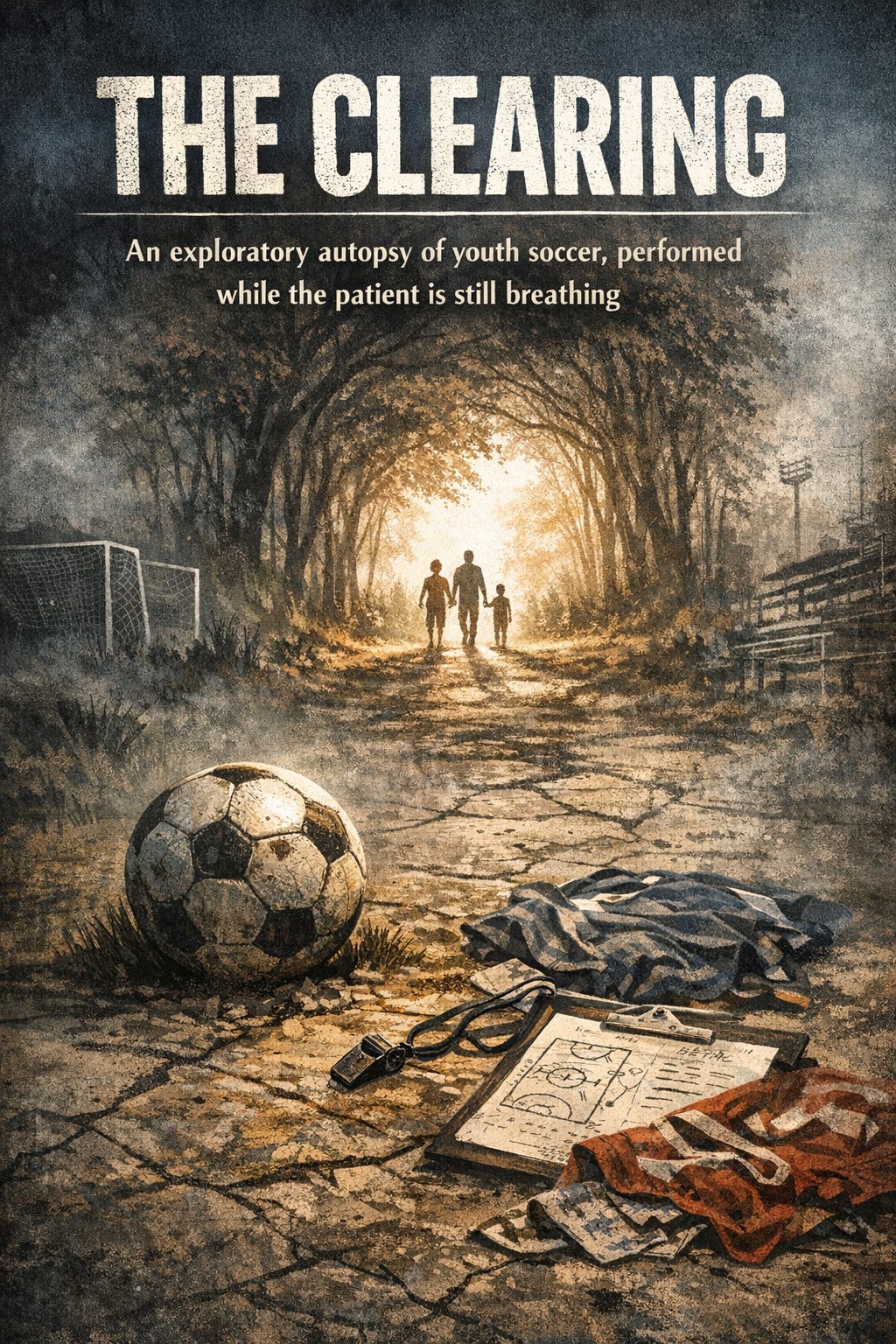
THE CLEARING
An exploratory autopsy of youth soccer, performed while the patient is still walking around.

I was mildly miffed the other day, which is my body’s courteous way of saying: something ancient inside me finally stood up, cracked its neck, and said enough. This isn’t new anger. This is long-stored clarity finally deciding to speak in full sentences.
So… fuck it. I’m saying it.
This Isn’t a Rant. It’s a Health Report.
I don’t write this stuff to win points. Not to provoke, posture, or harvest favor from the algorithm gods. I’m certainly not looking to build a brand, especially one that’s built on outrage. I’d rather eat glass than become another loud guy yelling into the ether for attention. I’m writing this because the health of the people inside youth soccer is actually at stake. All of us. Players, yes - but also parents, coaches, referees, administrators, club staff.
AKA - Human beings. Nervous systems. Relationships. Futures.
The American Soccer ecosystem has a choice to make. It can be a place where humans grow, connect, belong, explore, express themselves, and fall in love with effort… or it can continue being a slow, polite extraction machine that drains money, self-trust, and joy while calling itself development.
If we want the first version, we have to start with Truth. Not aspirational truth. Not the kind that photographs well or fits neatly on a slide deck. And certainly not the version whispered in a hallway with a director’s hand on your shoulder and a sales pitch tucked behind it.
Reality comes first.
Only then do we get to design the human experience around the game.
Because youth soccer didn’t break overnight. It wasn’t hijacked. It was slowly talked into confusion and carefully marketed into compliance. A game meant to be experienced was reshaped, piece by piece, into a product meant to be purchased.
So, let’s start by taking inventory.
Who’s Actually Getting Hurt?
Raise your hand if you know a player who went home after a game, laid in bed, and cried into their pillow… not because they missed a pass, but because they felt like they were the mistake. Like their performance meant something permanent about their worth and who they are.
Keep your hand up if you know a parent who’s lain awake at night staring at the ceiling thinking: My kid is dimming. Something about this is hollowing them out. And I can’t tell if I’m helping or complicit.
Keep it up if you know a coach who’s isolated, underpaid, overextended, and still shows up smiling every day because they can’t afford to show the truth. Or an administrator running the entire club operations like a Western Union operator receiving distress signals from every direction, while being treated as the most disposable part of the machine.
Now, look around, and put your hands down. We’re all standing in it.
These are not edge cases. These are the defining experiences of American youth soccer. This is our culture. And yet we keep pretending the machine is working because admitting that it isn’t would mean admitting something costly: financially, emotionally, socially.
And yes, someone will try to say, “But Jeb, pros are still being developed. So clearly it’s working.”
Sure. Casinos create millionaires, too. That doesn’t mean the system is designed for your well-being. And, more importantly, producing professionals was never supposed to be the universal objective of youth soccer. When we pretend it is, we shrink the game until something deeply human disappears. Dreams turn into pressure cookers, passion into deep surveillance, and joy into a condition.
Fear Is the Most ‘Elite’ Thing We Train
Over the last 20–30 years, I’ve watched youth soccer talk itself into confusion and called it sophistication. It got hectic. It got very loud. It got extremely “serious” about the wrong things. And now we’re standing inside a system that looks professional, sounds authoritative, and reliably produces the same fragile outcomes over and over again.
Everyone knows it.
Everyone feels it.
Almost nobody says it out loud.
Why? Because FEAR is the most elite skill in youth soccer right now. Olympic caliber, even. It’s in the walls around us and in the structural foundation beneath us.
“Don’t speak up, or you won’t make the team.”
“Don’t speak up, or you’ll lose your spot.”
“Don’t speak up, or you’ll lose your job.”
“Don’t speak up, or you’ll be quietly exiled from the imaginary inner sanctum at the top of the pyramid.”
Sound familiar?
The insidious part is that these veiled threats aren’t always spoken in words. They live in the nervous system, and in the water we’re all swimming in. You feel them before you can name them. They show up as tight shoulders, shallow breath, polite silence, over-polished emails, careful conversations, and strategic silence. Compliance masquerading as professionalism.
So we nod. We smile. We keep paying. We keep driving. We keep scheduling. We keep swallowing that low-grade nausea because this is just how it is.
Nope. Fuck that. Respectfully (sort of).
The ‘Exclusive Club’ Is a Costume Party
For a moment, just a moment, imagine we flip the pyramid of the hierarchical (and mythological at this point) pathway of elite American soccer. Imagine the badges and titles dissolve, and we talk as humans instead of roles. I’m not a fortune-teller, and you’re not a consumer. I’m simply someone who climbed the ladder, realized the top was mostly ego, money, and fear, and came back down to say: the “exclusive club” is largely a costume party.
I’ve been to the professional level. I’ve stood at the so-called top. And I returned to the youth game only to see the same arrogant behaviors in cheaper track suits. Same posturing, same certainty, same hierarchy, same fear. Only now, the audience is children.
That should stop us cold.
Because once we really stop pretending, the theater is impossible to miss.
It’s in the car rides where you swear you won’t talk about the game, but end up talking about it for forty minutes like you’re briefing the Pentagon.
It’s in the inexplicable tension felt at the dinner table. The weird silence after a loss. The way a single weekend tournament can send an entire household into an emotional tailspin.
It’s in the endless camps, seeking the exposure that’s supposedly seeking you. The “elite international experience camp” where someone with a sexy accent runs the same 4v2 rondo your kid does every Tuesday… except now they’re being cussed out in a different language, so it feels more profound.
It’s in the alphabet-soup leagues. The prestigious Elite W-T-F league, where you spend $4,000 in a weekend on flights, hotels, rental cars, and matching warm-ups… only to watch your kid get overwhelmed in the first ten minutes, start playing safe, and emotionally opt out by game three.
There’s a dark comedy behind it all, and it’s the part that would be funny if it weren’t wrecking families.
That same ass-kicking-type lesson could’ve been learned fifteen minutes from home. For free. On a familiar, slightly bumpier field. Against a better team. In worse weather. Without the “elite” soundtrack or $300/each sponsored banners lining the field.
But I get it. The logo wouldn’t have looked as good. So we keep going…
The Cathedral of Certainty
Rebrands. Mergers. Renames. Announcements of a new “vision” and club direction that’s plastered over a cracked foundation. Not solving any issue, but rather glossing over old harm and abusive treatment. Sometimes, we even slap a new fancy logo onto long histories and call it a reset.
In today’s world of youth development, we often confuse change with progress. We confuse growth in registrations with human growth, and we confuse motion with direction.
And then we look at the digital (online) noise layer, which has become the sacred cathedral of certainty.
Instagram coaches preaching like they’ve crossed a desert and returned with tablets. Pathways → Levels → Exposure. Promises delivered with cinematic confidence and zero humility. Parents (obviously) lean in because fear is persuasive and hope is expensive. Kids show up to the field tired, not lazy or soft, just emotionally overcooked, dragging their bags like they’re commuting to a 9-to-5 job they never applied for.
Somewhere along the way, fear got repackaged as opportunity. Urgency got repackaged as love for the game. And eventually, love for the game got repackaged as spending.
The tragic hum underneath the youth landscape is: Most kids aren’t missing opportunities to play. They’re missing opportunities to grow.
We’ve convinced families into believing that access to growth lives behind a paywall and that an expensive club equals better growth and status. That “real” soccer lives behind a velvet rope, and that the best players are only found in the most costly zip codes. That if you’re not constantly moving, upgrading, or chasing, then you’re falling behind.
Oofta. What a bad and dangerous misconception.
Right now, youth soccer feels like a cocktail hour. Everyone is talking. Everyone is networking, angling, and posturing. Everyone is claiming to be “building something uniquely special over here.” And yet, beneath the chatter, there’s very little slow, honest, uncomfortable work actually happening. Attendance has been mistaken for intention. Time on the field has been confused with progress. And looking serious (somehow) has been confused with getting better.
We market confidence without ever defining it. We sell the word elite like a clearance item we can’t move fast enough. We reward optics, follower counts, and personal brands far more than mastery.
And the part that should concern us all: the loudest voices, the rule writers, and the fastest money collectors are almost never the people who actually develop players. They are specialists in selling feelings.
The feeling of being one step closer.
The feeling of being seen and calling it exposure.
The feeling of ‘moving up’.
Yet, after all that investment, the same symptoms return.
Young players still panic when the game speeds up. They still can’t read space quickly enough, or they still freeze when decisions matter most, and the game is on the line. They still emotionally unravel the moment the environment stops being friendly.
So what does the system do? It does what it always does: It explains. It rationalizes. It invents clever language so nobody has to face the truth. We say things like:
“They just need more exposure.”
“They just need to try a different position.”
“Stick with it, sign up for another year, we’ll have you train for a month with the higher level team, and then next year you’ll move up.”
Move up to what, exactly? Another room with better lighting and the same unresolved problems?
Selling Visibility, But The Bill Is Coming Due
Anyone who has actually coached, I mean really coached, knows that development is chaotic, nonlinear, slow, and deeply human. It does not behave as we expect. It does not obey our preconceived timelines. It does not reward certainty. And because it can’t be guaranteed, this space becomes a feeding ground for people selling certainty they never earned.
What we’re selling in today’s youth game isn’t improvement. It’s visibility.
Exposure… but to who? For what?
We sprint kids toward showcases before they’ve built the nervous system and mental capacity to handle pressure, before they’ve built the awareness to read and ‘feel’ the game, and before they’ve built the anchored identity that can survive a mistake. Then, we act surprised when they implode: Their touch is gone, confidence is evaporated, decisions are frozen, all while the college coaches quietly packed up their stools on the sidelines and left ten minutes ago.
So, in our confusion, we blame nerves. We blame travel, timing, or the lack of preparation from the cancelled training dates leading up to the showcase due to weather.
Is that true? No. That’s just gravity. That’s the bill coming due.
And players, here’s a quick side note for you, because this part matters: Stop talking about the next level if you’re not showing up to this level with intention. Not hype. Not vibes. True, actual intention. There are hobbyists, and there are obsessed players. Both are valid, and one is not superior to the other. But chaos happens when someone lives like a hobbyist and expects the rewards of obsession.
There is no elevator to the Promised Land, and it’s anything but promised.
Logos don’t open doors.
Gear doesn’t open doors.
Facilities don’t open doors.
Proximity doesn’t open doors.
Only work does. Honest, unsexy, uncomfortable work.
And when that promise doesn’t materialize, when the phone stops ringing, when the dream cracks, the people who stole your watch and sold it back to you are already long gone. Onto the next rebrand. Onto the next cohort to mass manipulate, and to prey on the next hopeful family investing in a dream.
Here’s my uncomfortable truth and one of the main reasons I don’t work in club soccer anymore:
I don’t trust industry guidelines written to protect systems instead of kids. I also don’t trust certainty in a domain that requires humility.
Honestly, watching the “game around the game” in today’s youth soccer culture - the branding, the posturing, the shallow confidence theater - sometimes makes me want to disappear into the mountains and let the Wi-Fi die with me.
Because it’s exhausting.
Welcome to Club Nowhere
Youth development has become a marketplace of noise. Loud, shiny, fear-driven messaging with everyone guarding an imaginary velvet rope into American soccer’s ‘elite’ inner sanctum.
But when you pull the rope back, there’s nothing there. No hidden tier. No protected wisdom. No secret truth reserved for the chosen few. Just people selling proximity to prestige instead of the slow patience real development requires.
We’re no longer selling improvement. We’re selling the sensation of movement and the illusion of motion.
“You got noticed by the top brass.”
“You’re on our radar.”
“You’re on the list to move up.”
Not quite. You were just sold an emotion and a feeling of advancement.
Real improvement doesn’t announce itself. It doesn’t post well on social media. It’s boring to watch and brutal to live through. It’s slow, humbling, and, quite frankly, most days it can feel like regression. No applause. No dopamine hits. Just quiet rewiring and steady progress behind the scenes.
That doesn’t sell, though. So it gets buried.
Reality has a way of showing up when no one is ready for it, and in the soccer world, it usually happens between the ages of 13 and 18. A cut. A phone that doesn’t ring. A silence that cracks a young identity story right down the middle. And suddenly, everyone is confused, scrambling, because the truth was postponed for too long.
These kids didn’t fail.
They were guided by bad information and good intentions that never matched reality.
If this reads like whining, it isn’t. It’s humility. I’m still learning, and always will be. That’s how I know certainty here isn’t strength. It’s a warning sign.
So yeah. Fuck it. Let’s say the part we keep stepping around.
Where Do We Go From Here?
The development world doesn’t need more noise. It needs truth. It needs environments that were designed for humans, not systems. It needs soccer to become a place where nervous systems (individual and collective) can breathe, where coaches are supported, where parents can belong without fear, where refs aren’t treated like enemies, where development is slow on purpose, and where joy is not a reward for success but the fuel for growth.
We need to stop pretending the answer is another layer.
Not another league. Not another pathway. Not another “elite” tier with better fonts and worse travel schedules.
If the problem is human, the solution has to be environmental. It can’t be motivational or cosmetic. We must take a detailed look at the PH in the water we’re all swimming in.
Because I refuse to believe that people, especially kids, fail in isolation. Nervous systems respond to context. Behavior emerges from surroundings. So, if players are anxious, parents are frantic, coaches are burned out, and refs are quitting in droves, that’s not a coincidence - it’s a design flaw.
The question needs to stop being - How do we fix the players?
and becomes,
What kind of environment are we creating?
First, we slow the hell down - on purpose. Not as a luxury, but as a requirement. Development that’s rushed is development that lies. Real growth needs space, repetition, adaptation, boredom, frustration, recovery, and time to metabolize failure. If everything feels urgent, nothing is actually important. Fewer games. Fewer events. More room to breathe. More room to feel. More room to learn without the constant threat of judgment.
Second, we redesign environments to train humans, not just athletes. Confidence isn’t something you shout into a kid’s face - it’s something you build through safety, clarity, and ownership. Decision-making doesn’t come from drills alone; it comes from players being trusted to make mistakes without public punishment. Emotional regulation isn’t a “mental skills add-on”; it’s the foundation. If a player can’t stay present when the game speeds up, that’s not a character flaw; it’s simply a nervous system overwhelmed by the environment we put them in.
Third, we bring parents back into the ecosystem as humans, not financiers or sideline referees. Most parents aren’t crazy. They’re scared. They’re reacting to pressure they didn’t create and information they don’t trust. The solution isn’t shaming them, it’s educating them, supporting them, and designing spaces where they don’t feel like one wrong decision ruins their child’s future. When parents feel grounded, kids feel safe. When kids feel safe, development accelerates.
Fourth, we stop treating coaches like disposable labor. Burned-out coaches do not create healthy environments, no matter how good their sessions look on Instagram. Coaches need support, mentorship, financial stability, and permission to say “I don’t know yet.” The best environments are led by adults who are regulated, curious, and honest - not terrified of losing their job for telling the truth.
Fifth, we remove the imaginary velvet rope. Not metaphorically, but actually. No secret levels. No mystical inner circles. No “if you’re not here by 12, you’re done” bullshit. Development is not a ladder. It’s a landscape. Different timelines. Different routes. Different bodies. Different nervous systems. The moment we stop pretending there’s one correct pathway, we free everyone to actually grow.
And finally, and this might be the hardest part, we tell the truth early and always. Not harshly or cruelly, but clearly. We stop selling certainty in a space that requires humility and discovery. We stop promising outcomes we can’t control. We stop confusing visibility with readiness. We stop pretending proximity equals progress.
Because the goal was never to manufacture more professionals. The goal was to build environments where humans could grow, and where self-discovery emerged naturally through the game itself.
Soccer should be a place where kids learn how to compete and recover. Where they discover who they are under pressure. Where parents feel connection and meaning instead of constant fear. Where coaches can do meaningful, appreciated work without burning out. Where referees are treated like participants, not obstacles.
This isn’t about tearing the game down. It’s about clearing it.
Clearing the noise.
Clearing the fear.
Clearing the lies dressed up as opportunity.
And rebuilding environments where development is slow on purpose, joy is not conditional, and growth is something you can actually feel in your body.
That’s the work.
And it doesn’t start with another acronymed program.
It starts with telling the truth and having the courage to design something better once you do.
Excellent article, wanna add that? We also need a program to develop coaches. So they understand that coaching needs time, commitment, discipline, and patience.
If you keep this up, you'l be sued by every youth soccer club. On no. Not really because they are operating on their players and "buying" their way into the system. Remember why you guys got dq-ed in Hawaii? Bravo coached two teams at the same time. Wrong on the club; wrong on the system. Both claimed they were operating in the kids' interest. Every wrong thing with club soccer was exposed at that tournament. And all our kids went home for reasons off the field. The tourney officials didn't like Shultz; Bravo was too good; the club had competent coaches to coach both the boys and the girls. Both teams qualified for their championships. (Remember only the boys were dequed because the girls had a better chance.)